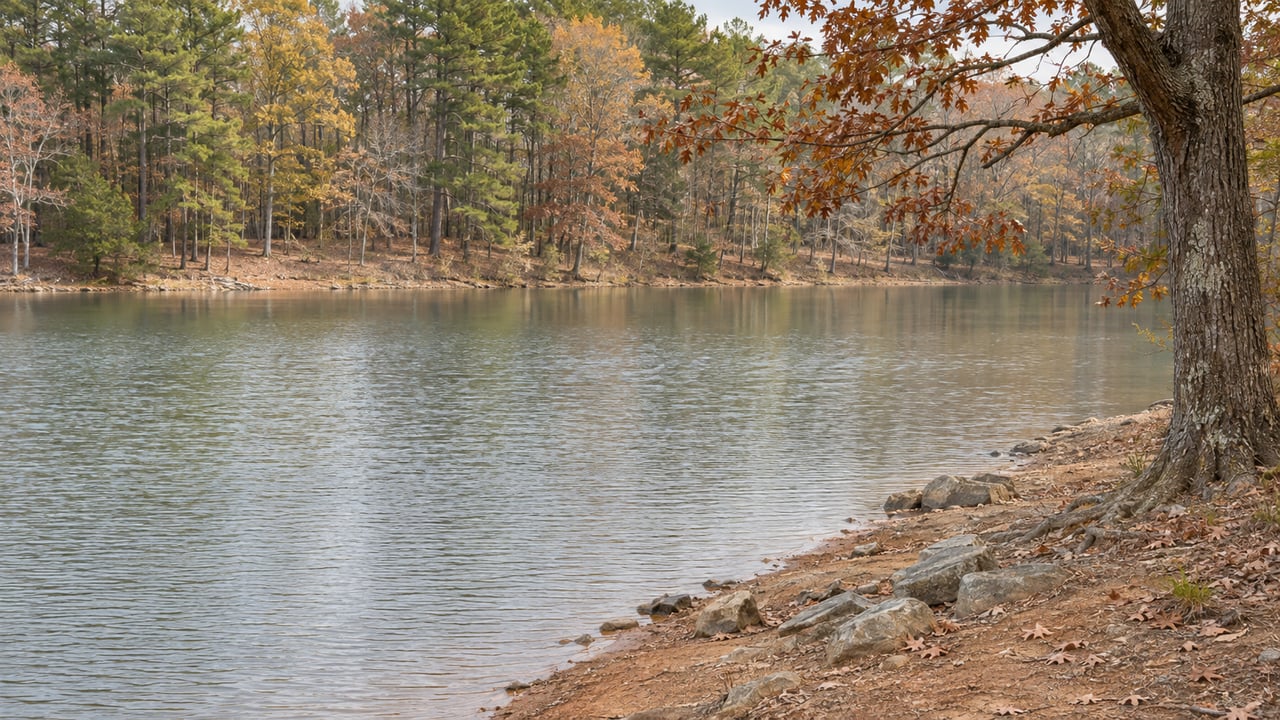
Duke Rowing has had to follow the water out. Linda Garziera told ABC11 in October that the team had moved its docks at Lake Michie closer to the water. "Our walk to the water has increased," she said, and some parts of the lake are now off limits because shallow water there would damage the boats. In the same October 19 report, ABC11 said Lake Michie Park and Marina had been closed to public recreation and boat launches for nearly four months.
That exposed shoreline also explains why the sprinkler heads in Trinity Park and Duke Park have been off since June. The drought covers all of central North Carolina. The water rules don't. Each utility's restrictions follow the size of its own reservoirs, and Durham's two reservoirs sit north of town in small watersheds that empty faster than its neighbors' do.
Two Lakes North of Town, Drawn Down Since Summer
The City of Durham announced Stage 2 restrictions on June 11, effective June 15. Updated modeling showed that the triggers for Stage 1 and Stage 2 had both been met. The city blamed the fast drop at Lake Michie and Little River Reservoir on extreme drought, little rain, warm temperatures and higher demand. The city's water shortage FAQ says the trigger was reached on June 8 and the system skipped Stage 1 entirely.
The fall readings show the decline:
Reading date | Combined lake storage | Days of accessible supply |
|---|---|---|
October 4, 2026 | 42.15% | 96 |
October 11, 2026 | 39.7% | 92 |
November 1, 2026 | 33% | 83 |
November 5, 2026 | 31% | 79 |
In mid-October the city said Hurricane Isaias had brought little rain to Durham's watershed. As of the November 5 figures reported by WRAL, Lake Michie was 12.71 feet below its full level of 341 feet and Little River Reservoir was 19.08 feet below its full level of 355 feet.
The rain that does reach Durham often misses the lakes. The National Weather Service office in Raleigh reported on October 27 that Raleigh-Durham International Airport had received 5.95 inches over the previous 90 days. That was 7.08 inches below normal, or 46% of the usual total. A storm on November 6 dropped 1.07 inches at RDU. As SoDu pointed out, though, a reading at the airport doesn't show how much rain fell on the Lake Michie and Little River watersheds. James Lim, the city's Water Efficiency Program Manager, told CBS 17 on October 20 that Durham needed a multi-day rain event over that watershed. Four days later he told Spectrum News the lakes were about 36% full, roughly half their normal level for that time of year.
Raleigh and Chapel Hill Have More Water in Reserve, and Durham Is Buying Some
Raleigh is in the same drought. Its water supply and drought status page, updated November 6, describes central North Carolina as in severe drought, including the Falls Lake watershed. On that page, Falls Lake's water supply pool stood at 63%, well above the 35% trigger the city sets for November. Raleigh lifted its Stage 1 restrictions on August 3. The Water Watch page for OWASA, the utility serving Chapel Hill and Carrboro, showed 62% supply and 283 days at recent demand, with only its standard year-round restrictions in place. In its November 5 report, WRAL described drought conditions across Durham County as moderate in some areas and severe in others.
Durham is closing part of that gap with its neighbors' water. The city's November 2 update said it was buying part of its Jordan Lake allocation through Cary, pumping from Teer Quarry and starting to buy water from OWASA. Joe Lunne, a senior public information and communications analyst with Durham's Department of Water Management, explained the Jordan Lake arrangement to WRAL. Durham holds its own Jordan Lake allocation but doesn't have the infrastructure to withdraw and treat that water itself. Durham pays Cary to treat its share and deliver it through the connections between the two systems, and from there it blends with the rest of Durham's supply. Teer Quarry is a former quarry that now stores water.
What Stage 2 Allows for a November Yard
Fall is a planting season that many experts consider the best of the year. That's the framing in a May 19 drought guide from N.C. Cooperative Extension's Durham County Center. Under Stage 2, the city's water ordinance bans spray irrigation with city water entirely. No day of the week is set aside for sprinklers. Three methods remain allowed:
- Hand watering, if someone is holding the hose or watering can and the hose has an automatic shutoff nozzle
- Drip irrigation
- Tree and shrub watering bags
New sod and seed run into a separate rule. In normal times, the ordinance lets an address get a written license to water new sod, seed or new non-turf plants during their first 45 days, up to two licenses a year. During a declared shortage, the city issues no new landscape exemptions. Exemptions issued before the declaration stay valid until they expire.
The Extension guide says to put trees and shrubs planted within the last two years first, because their roots haven't fully developed. It recommends watering slowly and deeply, ideally with a soaker hose or drip irrigation, early in the morning to limit evaporation. It also recommends mulch to slow evaporation and cool the soil.
The rules apply to anyone on city water, including some customers outside city limits. They don't cover private wells.
The Rules That Hit Holiday Prep
Sprinklers are only part of it. The rules also cover the usual pre-holiday cleanup: driveways, porches and the car before family arrives.
- Cars: Stage 2 bans washing vehicles at home with city water. Commercial and institutional car washes that comply with the rules may stay open.
- Hard surfaces: You can't use city water to wash exterior walls, decks, sidewalks, driveways or parking areas. The exceptions are preparing a surface for painting and addressing a health or safety issue.
- Pools, fountains and ponds: You can't add water to decorative fountains, pools or ponds unless it's recycled water. Swimming pool top-offs are limited to replacing what's lost to evaporation and spillage, plus what the chemical feeders need to run.
- Restaurants: Water is served only on request. That Stage 1 measure stays in effect under Stage 2.
Enforcement starts with warnings. After that, the ordinance requires corrective action for a first violation, a $100 penalty for a second, $250 for a third and termination of water service for a fourth. By November 2, Water Management had logged 475 complaints and reports and issued 17 violations since the restrictions began. This is a summary of public rules, not legal advice. If a project at your address depends on how a rule applies, confirm with the City's Department of Water Management or the right professional.
How Close Stage 3 Is, and What Ends the Restrictions
The Water Shortage Response Plan sets the Stage 3 trigger. Stage 3 starts when forecasts show at least a 10% chance that combined usable storage will fall below 25% within eight weeks. Storage was 31% on November 5, the same day Lunne told WRAL:
"While we are getting close to hitting the trigger for Stage 3, we aren't there yet."
Stage 3 would ban nearly all outdoor use of city water, with a short list of exemptions. Customers who use more than 100,000 gallons a day would have to try for a 50% reduction, up from the 30% target they face now.
The plan sets a much higher bar for lifting restrictions. A stage can be rescinded when forecasts show at least a 95% probability that combined usable storage will reach 95% within 10 weeks. Managers can also delay rescinding a stage based on other conditions in the system. Lake Michie and Little River would have to climb from roughly a third full to nearly full to meet that bar. A one-inch storm at the airport won't do it. It would take the kind of multi-day rain over the northern watershed that Lim described.
For the reading on any given day, the city posts lake levels and supply on its Current Data page and status changes through its water shortage updates.
A garden on an in-town lot, with its mature oaks, foundation boxwoods and long-established perennial beds, takes years to grow and only a dry season to stress. If you're planning spring landscaping, weighing how a dry yard will look in listing photos, or wondering which plantings to protect first, Tim Hock Properties is glad to walk the property with you. Schedule a Personalized Consultation.
