In late June a cover lay across the pool at Forest Hills Park, behind the white clubhouse on University Drive. A CBS 17 photographer caught it that way for a story about Durham running a single outdoor city pool for the summer. The cover is the last stage. On November 3, the City of Durham issued a project manual for the "Forest Hills Park Playground & Sprayground," and its summary of work is short: "Demolish existing playground, sprayground, pool and related infrastructure. Build new playground, sprayground and restroom, including utilities, hardscape and landscape."
The new plan does not include a pool. For anyone who walks this park often, though, the more useful fact is how old each piece is. The pool, its pump house and its bath house belong to the park's mid-century additions. The clubhouse, the creek, the concrete road bridge and the open ground of the old golf course belong to the 1920s, and the federal historic record counts those as the park's historic core. None of them is on the demolition list.
Start at the Clubhouse
The building facing University Drive at 1639 is older than the park itself. The 2005 National Register nomination for the Forest Hills Historic District describes it as a one-story, side-gabled Colonial Revival building. It has a three-bay porch with paired and tripled boxed posts, weatherboard siding, six-over-six sash windows and chimneys at each end. George Watts Carr Sr. designed it in 1928 as the clubhouse for the Forest Hills golf course, replacing an earlier clubhouse that had burned.
It was a clubhouse for barely a year. In 1929 John Sprunt Hill bought the course and the clubhouse at a bankruptcy auction. From 1933 to 1937 it held classrooms for the Calvert School. In 1938 Hill gave the property to the city as a public park, on the condition that the clubhouse serve as a library for Forest Hills residents. It is now the Forest Hills Recreation Center, and the nomination lists it as a contributing building, which means it counts toward the district's historic character.
That status covers more than the building. Forest Hills was listed on the National Register on December 28, 2005, and the nomination counts the park itself as a contributing site.
Behind It, the Mid-Century Layer
The same 2005 inventory moves on from the clubhouse to the pool, and the dates change. It lists an inground concrete swimming pool from about 1960, an L-shaped concrete block pump house from about 1960, and a concrete block bath house with a one-bay garage from about the same year. All three are marked noncontributing, as are the picnic shelter from about 1980 and the playground equipment and wooden gazebo from about 2000.
Swimming here goes back further than that concrete. When Forest Hills was being marketed in 1923, a newspaper account listed a clubhouse, a swimming pool and a golf course among the neighborhood's planned amenities, according to Open Durham's history of the neighborhood. When the pool's closure became news this summer, Durham Parks and Recreation told CBS 17 the pool was more than 100 years old. Swimming at this spot has a century behind it. The basin under the cover dates from about 1960.
How the Pool Closed
The pool's last announced season was 2025. That May, the city said Forest Hills and Hillside pools were scheduled to open June 4, daily from 1 to 5 p.m. In 2026 Forest Hills did not open. Mary Unterreiner, the department's Culture and Community Manager, told CBS 17 that the department had "been planning to close it for probably a little over a year now," and that "this year, we didn't open it because of budget cuts that came in, so it was a little bit of a cost savings this season." The station reported that the pool had closed for good. The pool's page on the parks department's facility site still says only that it "will remain closed at this time."
The replacement project has been in the city's capital plan for a while. In the fiscal year 2025-26 fourth-quarter capital report, covering the year that ended June 30, 2026, "Forest Hills Park Play & Spray" had $1,293,750 authorized and $282,672 spent or encumbered. Design was 80 percent complete, but construction documents had been "put on hold per revised direction from DPR." The November 3 manual moves it forward again, and the demolition now covers the pool along with the old playground and sprayground.
What the Bid Asks For
The project manual sets a December 10, 2026 bid deadline at 2 p.m. at the city's General Services Department on Fay Street. Written questions are due December 3. A non-mandatory pre-bid conference was held at the park on November 10. With bids still open this week, the contractor and the construction start are still to come. The manual gives the work a 275-day completion period.
The work list includes a new restroom along with the playground and sprayground. The only restrooms in the 2005 inventory are in the picnic shelter from about 1980. The sprayground is being rebuilt as part of the same contract. When the work is done, the pool, old playground and old spray pad will have been replaced by a new playground, a new spray pad and a restroom.
Past the Pool, the Old Golf Course
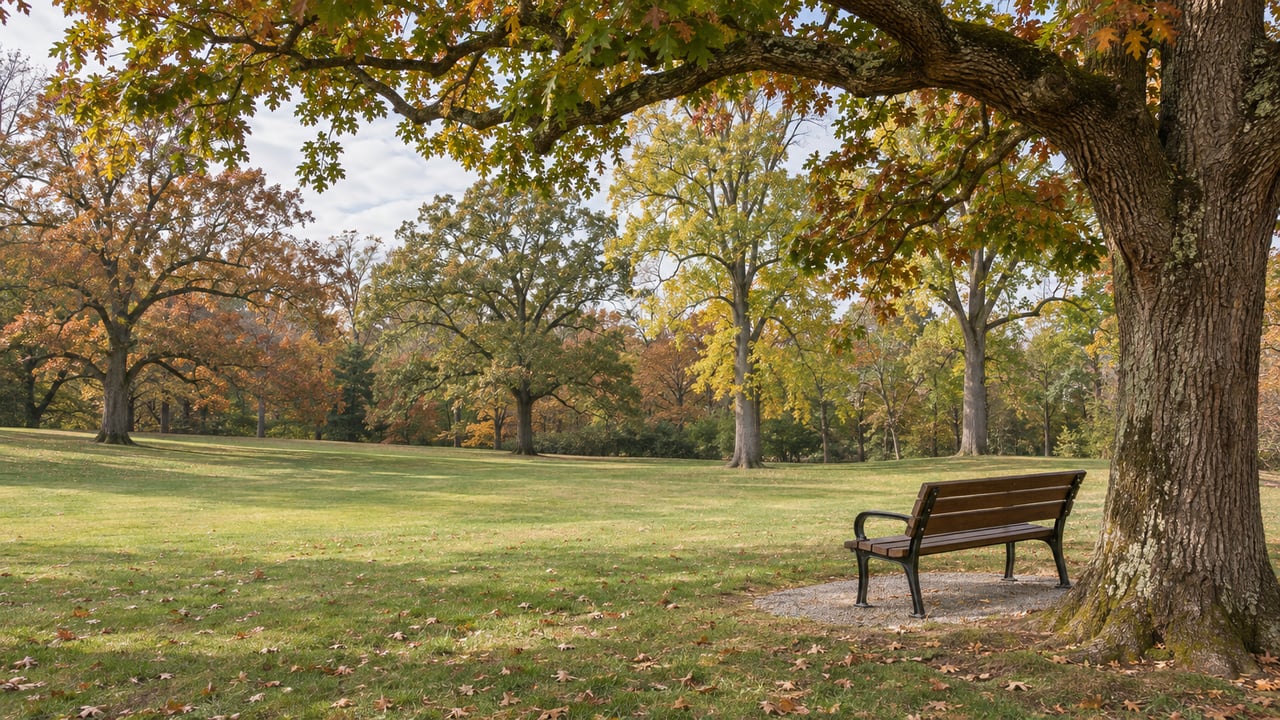
Walk away from University Drive and the park looks much as it has since the 1920s. Forest Hills was laid out in 1917 by landscape architect Earle Sumner Draper, with curving streets that follow the creek bottoms around a nine-hole golf course. The nomination describes the park as an irregular tract in four sections, bounded and crossed by University Drive, Forest Hills Boulevard, Forestview Street and Beverly Drive. A creek meanders through it under modern wooden footbridges, and the large oaks and lawns made the parkland, in the nomination's words, "an urban oasis." The section along Beverly Drive was added around 1951, when that street was laid out.
Where East Forest Hills Boulevard crosses the creek, it rides on a concrete bridge from about 1925 with paneled concrete railings, and the Register lists it as contributing. The houses facing the park belong to the same plan. Pinecrest at 1050 West Forest Hills Boulevard and the Bugg House at 410 East Forest Hills Boulevard are both named in the nomination. So are the Colonial Revival and Tudor Revival houses on the Oak Drive loop, where Carr also worked. The parks department lists the park at 45.86 acres, with trail access, a picnic shelter, grills, swings, tennis courts lined for pickleball, and the playground and sprayground now slated for rebuilding.
None of that is in the demolition scope. The courts, the shelter, the creek paths and the clubhouse porch are where they were.
Swimming Next Summer
For households that used Forest Hills as their summer pool, the city's outdoor options are thin until the end of the decade. In June 2026, CBS 17 reported that Hillside Pool was the city's only open outdoor pool and that Long Meadow Pool had closed a few years earlier. For indoor swimming, the city operates Edison Johnson Aquatic Center and Campus Hills Pool.
The bigger replacements are years away. Durham Parks and Recreation told CBS 17 it is building a recreational pool around East End Park and a new Aquatic Center at Merrick-Moore Park, both slated for completion in 2030. In the same capital report that paused the Forest Hills design, the East End Long Meadow project carried $42 million in authorized funding and was 5 percent through design as of the end of June 2026. The spray pads have their own caveat. This summer the city's three spraygrounds were slow to open because of the drought, which is also behind the water rules Durham is still living with this fall.
For a family on Hermitage Court or Westwood Drive, the plan of record is a new spray pad, playground and restroom by the clubhouse once the 275-day contract runs its course, with East End and Merrick-Moore slated for 2030.
The Forest Hills homes we love most are the ones whose porches look onto Draper's 1920s plan, with the creek, the oaks and Carr's clubhouse in view. If you live along the park and are wondering what the new play area and the loss of the pool might mean for your own block, Tim Hock Properties is glad to talk it through over coffee, with plenty of time for the porch stories. Schedule a Personalized Consultation whenever it suits you.
