Ben Hogan once called the 11th hole at Hope Valley one of the greatest in the world. After someone filled in the creek that crossed the right side of its fairway, he said the change "ruined" it, as Triangle Golf reported in October. Next year the creek comes back. Greensboro architect Kris Spence starts work on the Hope Valley Country Club course in January, and the club expects the course to reopen in mid-to-late fall 2027.
Golfers will read that as news about greens and bunkers. Anyone weighing a house in southwest Durham should read it as news about back yards. Hope Valley was planned around this course a century ago, and its houses span six building eras on lots that turn their backs to the fairways. With so few sales each year and so much variety from one house to the next, a neighborhood average says little about any one house, and the zip code average says even less.
The Course Came First, and the Houses Face Away From It
Robert Jesse Mebane and Walter E. Sharpe planned Hope Valley as an upscale golf-club suburb southwest of Durham. They tied the course, the clubhouse and discounted home lots to a club of 250 members. Robert B. Cridland laid out the streets around Donald Ross's course. Aymar Embury designed the clubhouse, and George Watts Carr designed at least ten speculative houses, most of them Tudor Revival or English Cottage, with some Spanish Revival and Colonial Revival as well. The National Register nomination describes the curving street plan as built around the course, with the course as the organizing landscape of the whole development.
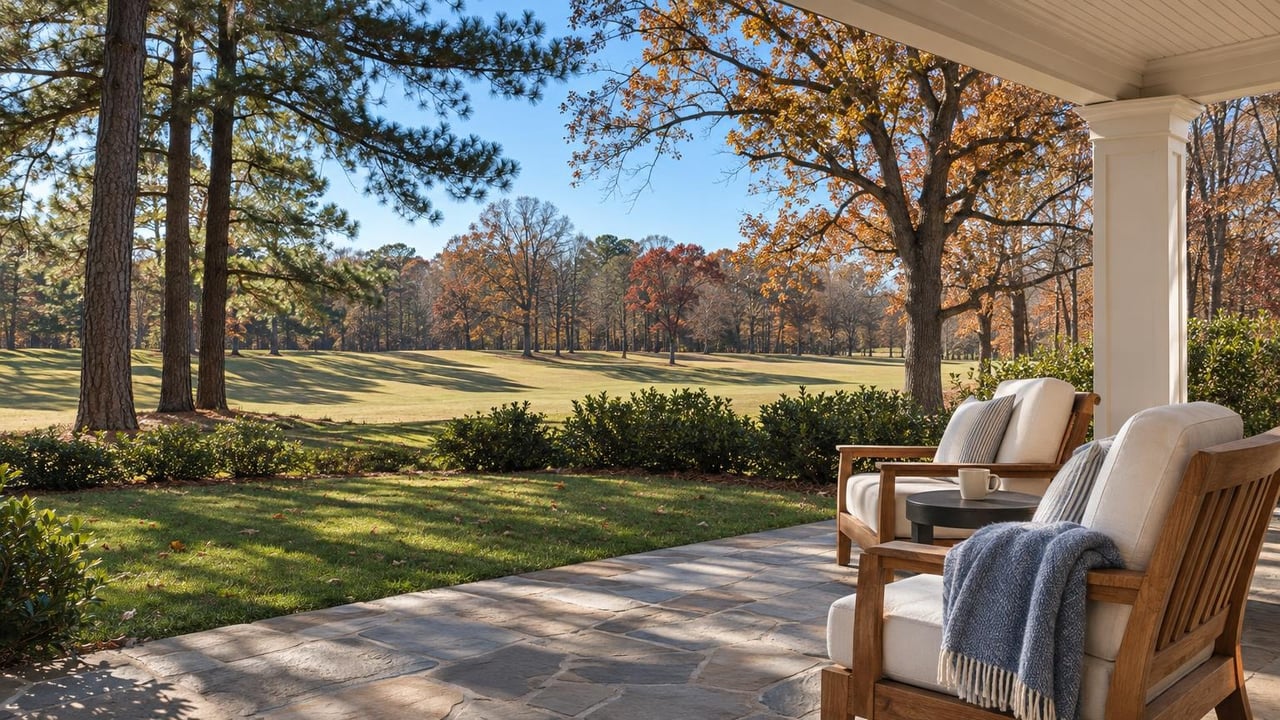
The nomination also records an unusual detail. Houses here do not face the golf course. Where a facade looks toward the greens, a road runs between them. The houses right next to the course turn their backs to it, and their back porches, patios and terraces open onto the fairways.
That arrangement explains why the 2027 restoration matters to course-side owners and buyers. Spence plans to rebuild the greens to the height and contours of Ross's 1926 drawings, take the bunker count from 55 to 59, sod the fairways in Zeon Zoysia, and do major irrigation and drainage work. He has also already removed many trees. For a house whose terrace opens onto the course, those changes show up as a new view from the back of the house, and for most of 2027 that view will be a construction site.
Six Building Eras on One Plat
The Hope Valley Historic District was listed on the National Register on December 11, 2009. It covers about 300 acres, including all of the country club and the course. The nomination counts 80 contributing buildings and 90 noncontributing ones. That near-even split reflects how the neighborhood was built: slowly, one house at a time, over decades.
| Era | What was built | Survivors counted in the nomination |
|---|---|---|
| 1927 to 1930 | Large, architect-designed period revival houses, mostly Tudor Revival, some with stone matching Duke's new quadrangles | 19 houses |
| 1930s | More period revival houses, building steadily through the Depression | 17 houses |
| 1940s | Small Colonial Revival houses | 6 houses |
| 1950s | Ranch houses with classical or Modernist details, a few Modernist houses, Cape Cods, later Colonial Revival | 30 houses |
| 1960s onward | Ranch houses, then two-story Colonial Revival and a few Contemporary designs, at less than one house a year | Not tallied by decade |
| 1990s and 2000s | Large Neo-Craftsman and Neo-Colonial houses that borrow historic styles | Not tallied by decade |
The oldest building is an early nineteenth-century Federal-style farmhouse that the developer moved to Chelsea Circle in 1927. Every other building dates from 1927 or later. The stone link to Duke is the detail the nomination dwells on. Several early houses have stone veneer or heavy stone accents that match the stone in the quadrangles Duke was building at the same time.
In practice, a 1928 Carr Tudor, a 1950s Modernist ranch and a 2000s Neo-Colonial can share a street. If you are comparing houses here, the year built and the architect tell you more about what you are looking at than the street name does. Our guide to the architectural styles that define in-town Durham homes covers how those eras read in person.
The Newest Layer Is Still Going Up
The 1990s were not the end of it. One house shows how far the newest era has gone. In September 2024, the News & Observer reported a listing at 3322 Devon Road: a modern house built in 2022 on 1.02 acres in the Hope Valley Country Club neighborhood, 8,019 square feet in total, asking $7.995 million. That was an asking price, not a sale. A buyer touring Hope Valley this winter can walk from a 1920s Tudor to a house finished in the 2020s without leaving the neighborhood, and the comparable sales for each will come from very different houses.
What the 27707 Median Misses
Look up Hope Valley by zip code and you get the wrong neighborhood. A data snapshot of Durham's 27707 dated November 23, 2026 tracks 277 closed sales over the previous six months, with a median sold price of $428,000. The middle half of those sales ran from $283,000 to $604,000. The same snapshot shows 83 active listings and 5 pending sales. Those figures describe a big, varied zip code, and Hope Valley sits near the top of it.
Durham County property records give a closer picture. The county's Hope Valley appraisal neighborhood has 588 single-family homes, and 27 of them recorded sales between mid-September 2025 and mid-September 2026. The median sale was $1,000,000, the middle 80 percent ran from about $640,000 to $1.44 million, and the top sale was $3,605,000. In that same September 2026 county data, the median heated area is 3,429 square feet and the median lot is 0.59 acres.
The difference matters for two reasons. The neighborhood median runs more than twice the zip median. And with 27 sales in a year among 588 homes, a single sale can move that median noticeably. With so few sales a year, the useful comparisons are the handful of nearby houses most like the one in front of you. An older marker from the News & Observer shows how wide the top end can stretch: a house in the 3100 block of Cornwall Road sold for $2,555,000, or $575 a square foot, on October 3, 2023. Pricing a house here works the way we describe in Pricing a Character Home in Durham's In-Town Market: you compare against a handful of real neighbors, and averages don't help much.
Buying Into a Closed Course
The timing adds one more variable. The club marks its centennial in 2026, having been founded in 1926 alongside a neighborhood designed with the course. Aaron James became general manager in May under the management company Bobby Jones Links. The par-70 course runs 6,720 yards. Perry Maxwell, Dan Maples, John LaFoy and Brian Silva have all changed it over the decades, Silva most recently in 2003. Spence is working from a full set of Ross's original drawings.
A course-side house bought this winter will spend its first year looking at bare ground, new bunkers being built with capillary concrete, and a creek being dug back into the 11th fairway. When the course reopens, the view will be a closer copy of the 1926 layout than anything an owner has seen since the early renovations. Walk a course-side terrace in December and you see where Spence has already cleared trees; by next summer the same view is a work site, from a rear elevation the original planners built to face that course.
A Few Questions Buyers Ask
Do you have to join Hope Valley Country Club to live in Hope Valley? The club is a private club with its own membership, and its membership page describes a range of membership types aimed at people who live nearby as well as those out of state. Most of Hope Valley has no mandatory neighborhood HOA. County records show associations for the Surrey Green and Oldfourth sections.
When does the course close and reopen? Work begins in January 2027, and the club expects the course to reopen in mid-to-late fall 2027, according to Triangle Golf.
If you're weighing a Carr-era Tudor against a newer house a few lots away, or wondering how a course-side terrace should figure into an offer during the restoration year, Tim Hock Properties can go through the comparable sales house by house with you. Schedule a personalized consultation, or start with a home valuation if your own Hope Valley house backs onto the fairways.
